The short version
- The Netherlands imports nearly all the wine it drinks, and English is used routinely in the trade, which keeps a first approach straightforward.
- Rotterdam makes the country a logistics and re-export hub, but re-export volume is not the same as an importer's commercial territory. Ask what the importer actually sells, and where.
- Retail is value-led and supermarket-dominated, while specialist merchants and the horeca support higher-value wine. That second layer is where a small winery belongs, through a specialist importer.
Contents
The Netherlands is often skipped on the way to Germany or the UK. It is not a large consumer market, and it grows essentially no wine of its own, which is precisely why almost every bottle sold there is imported. It is also one of Europe's main logistics hubs, so a substantial part of what arrives in the country leaves again. Those two things are worth keeping apart: national consumption is one figure, re-export is another, and only the first tells you what a Dutch importer can sell at home. As a fellow EU country there is no customs, tariff or permit layer to manage, so the question is entirely commercial.
A small market that imports almost everything
The Netherlands imports a lot of wine for its size, around a billion and a half dollars a year, which ranks it among the largest wine importers in the world by value. Part of that total is wine that moves onward rather than wine consumed in the country, so the ranking overstates the size of the home market. France is the leading supplier, with Italy and Spain close behind, so the trade is already used to selling wine from the major European regions. Domestic production is negligible, which means there is no home industry to protect and no local style competing for the shelf.
Per-capita consumption sits in the mid-teens of liters a year, modest but stable, with red the most popular style. This is not a market that will move large volume for a small winery, but it is a steady one, and a good wine placed with the right buyer tends to hold its position.
Re-export: what it does and does not mean
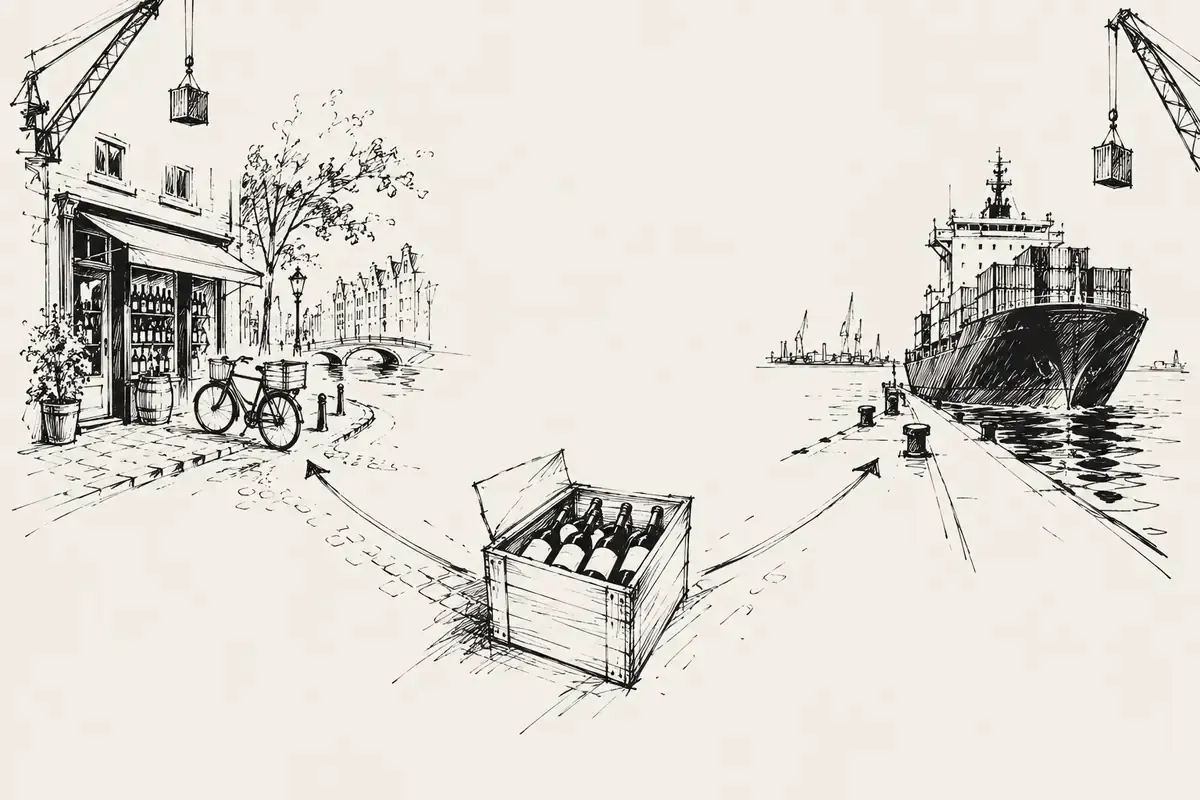
Rotterdam is the busiest port in Europe, and a large share of what the country imports is re-exported. Wine is no exception: it arrives in Rotterdam, is warehoused, and is shipped onward across the continent, with neighboring Belgium a significant destination.
That matters for logistics, and it is easy to over-read commercially. Goods move freely inside the EU single market, so a bottle warehoused in Rotterdam can reach a customer in Belgium or Germany without a customs formality. Whether your importer may sell it there is a separate question, settled by your agreement and by the sales network that importer actually operates. Some Dutch companies do carry a genuine Benelux or wider European territory. Many sell only into the Netherlands. Ask which one you are speaking to, and ask for the customers behind the claim.
Language and business practice
English is used routinely in the Dutch wine trade, which removes the language barrier that can slow a first approach elsewhere. Commercial discussions tend to be brief and specific: buyers ask for prices, volumes and technical detail early, and expect them in usable form. For a French or Italian producer, that is a practical convenience, and it makes the Netherlands a sensible market in which to test an export approach for the first time.
Where the wine is sold
Most wine in the Netherlands is bought off-trade, with supermarkets taking the great majority of volume, led by the largest chains, alongside a strong specialist retail presence and a growing online channel. That mainstream retail is value-led, much of it built on keen prices and private label, and it is not where a small winery competes. The horeca, meaning hotels, restaurants and cafes, accounts for a smaller share of volume but carries better margin and more room for a wine that needs explaining.
Alongside that mainstream there is steady demand for higher-value wine, served by specialist importers and merchants who build curated ranges for drinkers who want more than the supermarket offers. That specialist and horeca layer is where a small producer belongs, and it follows the same two-speed pattern found in most mature European markets.
Where a small winery fits
Leave the supermarket shelf and the private-label volume to the suppliers built for it. Aim at the specialist importer who supplies independent merchants and the horeca, whose customers are looking for character, provenance and a point of view rather than the lowest price. A French winery with a distinctive wine, or an Italian grower with a clear style, fits that curated trade well, and answers here tend to come back quickly, whether they are yes or no.
Goods move freely inside the EU single market. Whether your importer may sell them there is a separate question.
What to prepare before you approach
Come to a Dutch buyer with the commercial detail ready: a clean price list with the Incoterms stated, accurate technical sheets, available volumes and a clear account of what the wine is. Vague answers cost time, and decisions often come back faster than in markets where a first meeting is mainly an introduction. That works in your favor, because you learn where you stand sooner. The online channel also carries more weight here than in many markets, so a wine whose story reads clearly on a screen, without a salesperson beside it, travels further.
A realistic first step
The Netherlands rewards a clean, businesslike entry: a considered price, clear materials and one well-chosen importer with genuine reach in the specialist and horeca channels. Because responses tend to come back quickly, it is an efficient market to test early, and if the fit holds it can be a sensible base from which to look at neighboring markets, provided the importer's territory genuinely extends there.
How to find the right importer
With no customs or compliance layer between an EU producer and the Dutch market, finding the partner is the whole task. The method is the usual one: match yourself to an importer whose existing portfolio already sits next to yours in style and price, and favor those with strength in the specialist and horeca channels rather than the supermarket suppliers. Look at who imports comparable wines, and reach the right few directly and consistently.
Two questions settle the choice. Does the portfolio fit yours in style, price and channel? And what territory does the importer actually cover, meaning the customers it invoices rather than the warehouses it uses? A Dutch partner with real Benelux or wider regional distribution is worth more than the domestic market alone. One that sells only within the Netherlands is still a legitimate partner, provided you price and plan on that basis.


