The short version
- Germany is the world's largest wine market by volume, and one of the few large markets where import value rose in 2025 while volume fell, meaning a higher average value per bottle.
- Around half the wine sold goes through discounters, on terms a small winery is unlikely to be able to meet. That is not the channel to target.
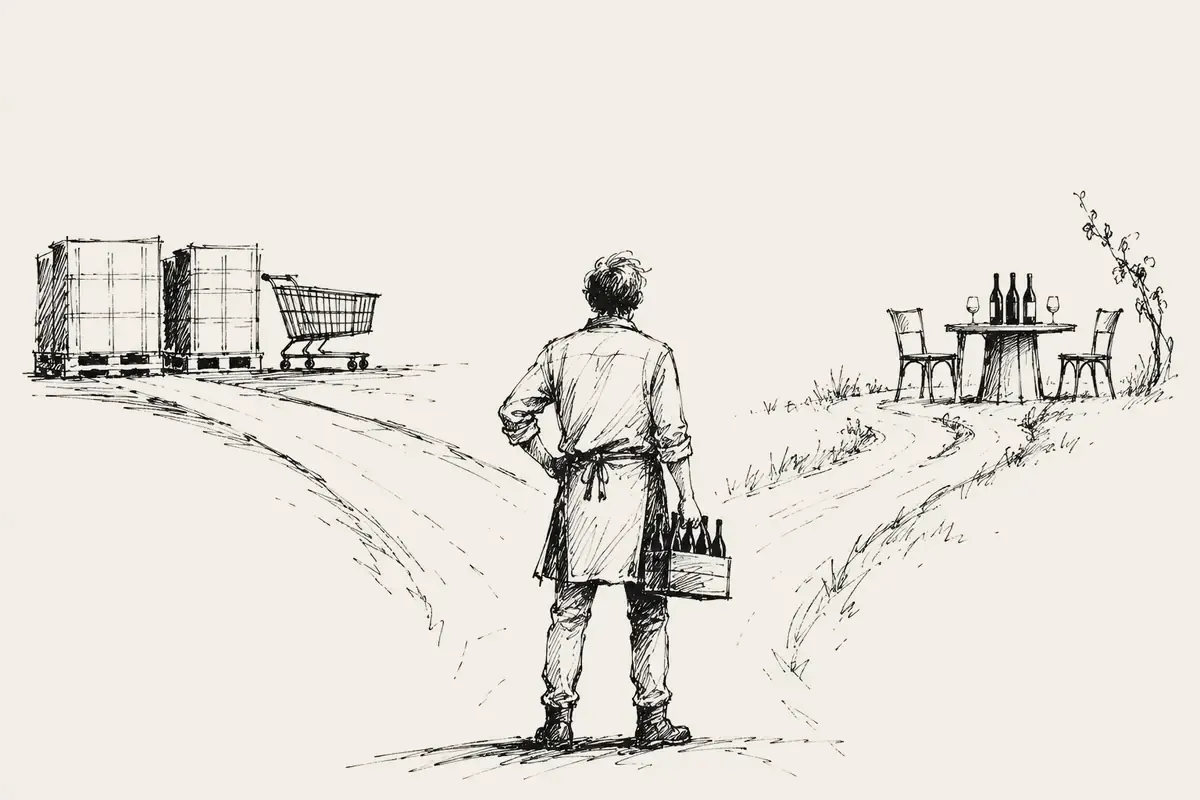
- The relevant Germany is the other one: the specialist Weinhandel and the on-trade, reached through a specialist importer rather than a retail buyer.
Contents
For a French or Italian producer, Germany is close, large and straightforward to ship to. As a fellow EU market there is no customs, no tariff and no import permit between your cellar and a German shelf, and you ship inside the single market as you would to the next region. That removes the friction that puts producers off the United States or China. It does not remove the need to understand who buys wine in Germany, because the country sells wine through two very different channels, and only one of them is likely to have room for a small producer.
The shape of the market
Germany drinks a great deal of wine and imports most of it. It is the world's largest wine market by volume, and while consumption has softened, to around 21 liters a head and still drifting down, the value story is healthier than the volume story. In 2025 the value of German wine imports rose more than five percent, to roughly 2.66 billion euros, even as the quantity slipped. Buyers took slightly less volume at a higher average price, the same pattern visible across several mature markets. Italy is the largest supplier by both value and volume, France second by value, Spain third. For a producer from either of the top two, that is reassuring: the German trade already knows how to sell your region.
The higher-value and organic segments are substantial rather than marginal. Organic wine is now around fifteen percent of the German market, one of the highest shares anywhere, and there is demonstrated willingness to pay for provenance and sustainability where the source is credible. The average bottle sold in Germany is inexpensive. The bottle sold through the specialist trade is not, and there is enough of the latter to build a business on.
The two Germanys
Roughly half of all the wine sold in Germany goes through discounters, Aldi and Lidl above all, with Aldi the single largest wine seller in the country. Add the large grocery chains, Rewe and Edeka, and you have the Germany that moves the volume: very large, strongly price-led, built on private label and on bottles that reach the shelf for a few euros. This is the part of the market that gives Germany its reputation for cheap wine.
It is also the part most small producers should set aside. The discount buyer works in container loads at prices a small winery is unlikely to be able to meet, reviews suppliers on cost, and has little use for the story behind the wine. That is a legitimate and very well run business, simply built for a different kind of supplier. Producers who chase that shelf and fail often conclude that Germany as a whole is closed to them, when they were addressing the wrong channel.
The other Germany is the specialist Weinhandel, the independent wine trade, together with the on-trade of restaurants and wine bars. Here a buyer will taste a grower's wine, learn the place it comes from and sell it on that basis, and here Riesling, Sekt and higher-value imported wine find their customers. It is smaller in volume than the discount channel, and it is the one with room for a small producer, at margins that work.
Where a small winery fits
Picture the specialist importer's customer. It is a Fachhandel merchant, the specialist wine retailer whose shop is built on wines the supermarket does not carry, or a sommelier assembling a list with a point of view. Both are looking for what the discount channel does not supply: character, an identifiable producer, a region explained properly, and a price that reflects quality rather than undercutting it. A French winery with a well-made mid-priced wine from a region the German trade already sells, or an Italian grower with a distinctive style, is a credible proposition for that trade.
German taste has its own reference points. This is the home of Riesling and of Sekt, so acidity, freshness and site expression are familiar terms for the specialist trade. Wines with structure and a clear sense of place are straightforward to explain in that context. If that is what you make, the conversation starts on ground the buyer already knows.
The average bottle sold in Germany is inexpensive. The bottle sold through the specialist trade is not.
Target a specialist importer, not a retail buyer
The most useful instruction for Germany is this: approach a specialist importer rather than a retail buyer. The retail buyer works in pallets and shelf margins. The specialist importer works in producers and ranges, carries a curated selection into the independent trade and the on-trade, and is the partner able to place a wine like yours. Finding the right one is the task here, as in most markets: an importer already selling your region and price band will understand the proposition quickly, while a generalist with no experience of your style has more work to do, however good the bottle.
How to find them
Three routes do most of the work. The first is ProWein in Düsseldorf, still the largest wine trade fair in the world and the place German specialist importers come specifically to discover producers, even after a few years of slimmer attendance. Being there, or being represented there, puts you in front of the right buyers in one room. The second is the directories: the German wine institute and the trade bodies publish importer listings, and a comparable wine on a German merchant's shelf names its importer on the back label. The third, and the one that scales, is direct, targeted outreach to the specialist importers whose range sits next to yours, reached consistently rather than once.
One regional note. Germany sits alongside Austria and Switzerland in the German-speaking DACH area, and some importers cover more than one of those countries from a single base. A German partner can therefore extend into Austrian or Swiss distribution. The three markets run on different systems, Switzerland is outside the EU with its own permit and quota rules, and the networks do not always overlap, so ask what territory the importer actually serves rather than assuming a shared language settles it.
Germany is large enough to matter to almost any European producer, and specific enough that the choice of channel decides the outcome. The producers who do well here are rarely the ones who went after the discount shelf. They are the ones who set that channel aside, found the specialist importer serving the independent and on-trade, and sold the wine to the buyers most likely to value it.


