The short version
- Your ex-cellar price is the only number you fully control. Everything downstream multiplies it, so where it starts decides where it lands.
- Incoterms, EXW, FOB, CIF, DDP, decide who carries the cost and the risk between your cellar and the destination. Quote the right one and both sides know what they are agreeing to.
- Work back from a realistic target market selling price rather than forward from your cellar. By the time duty, three margins and tax are added, ex-cellar is often a third to a fifth of what the bottle costs in the shop.
Contents
This is a different question from what it costs to run an outreach campaign. That is about the price of finding importers. This is about pricing the product itself, the number on your offer, and it is what separates an export plan that makes money from one that quietly loses it. Most producers price their wine for the domestic market, add a margin they are comfortable with, and assume the same bottle will work abroad. Then the importer's numbers come back and the wine is either too expensive for the foreign shelf or leaves too little for anyone in the chain. The waterfall is worth understanding before you quote a single price.
Start with ex-cellar, the only number you control
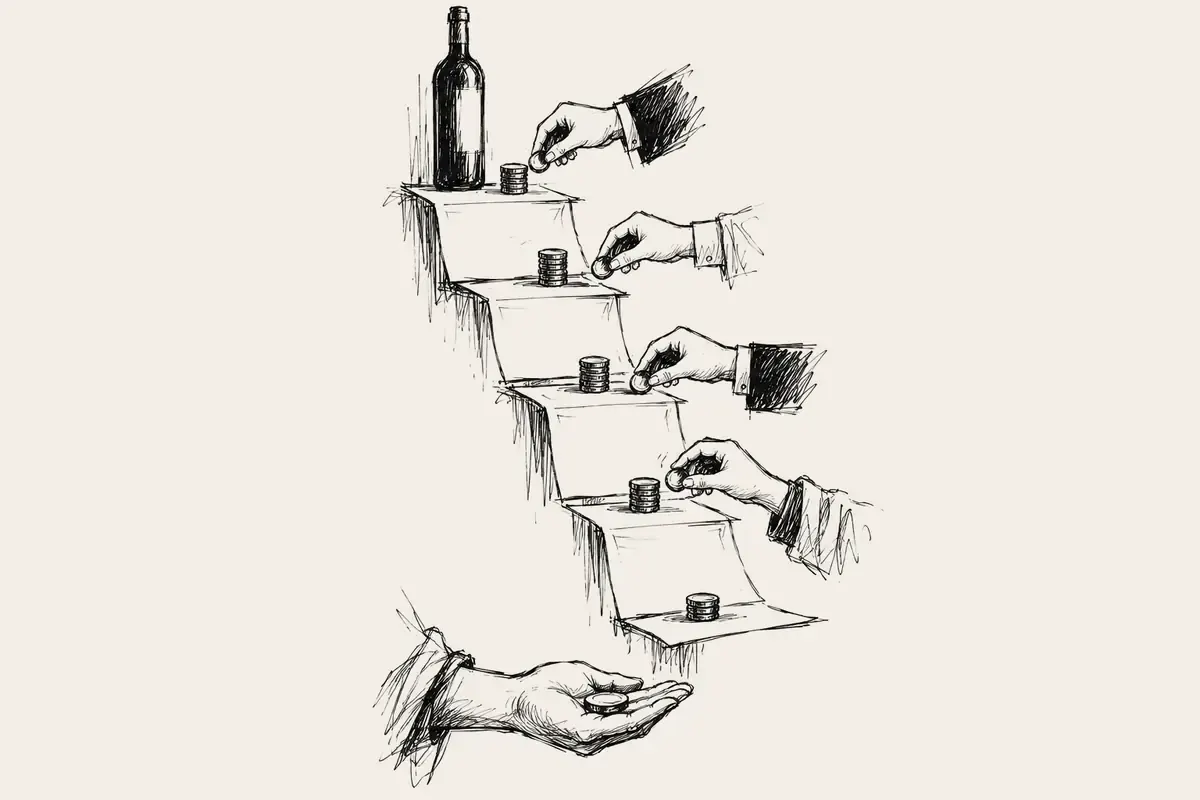
Your ex-cellar price, the price of the wine leaving your premises, is the foundation, and it is the one figure in the chain you fully control. Everything after it is a multiplication, and that is the part producers tend to underestimate. A euro added or saved at the cellar door does not stay a euro by the time the wine reaches a shelf in Tokyo or Toronto. It is marked up by an importer, marked up again by a distributor, marked up again by a retailer, and taxed along the way. A small difference at the start becomes a large one at the end. So the ex-cellar price is not a figure to set casually or to copy from your domestic sheet. It largely determines whether the wine can work in a given market at all.
Incoterms: who carries the cost, and the risk
The next decision is which Incoterm you quote, because that defines exactly where your responsibility ends and the buyer's begins. Four matter for wine.
EXW, ex works, is effectively your ex-cellar price. The buyer takes the wine at your door and carries every cost and risk from there: transport, export formalities, freight, insurance, everything. It is the simplest quote for you and the heaviest for them.
FOB, free on board, means you get the wine to the departure port and loaded, and the buyer takes over the sea freight and insurance from there. Risk passes to them once it is on the vessel. This is a common, comfortable middle ground for export.
CIF, cost insurance and freight, means you pay the freight and insurance to the destination port. Note the distinction: under CIF the risk passes to the buyer once the wine is loaded on board at origin, even though you are paying to get it across. You are covering the cost of the journey, not the risk of it.
DDP, delivered duty paid, is the maximum you can take on. You deliver to the buyer's door with duty and clearance paid. It is attractive to an importer because it removes work at their end, but it places all the cost, risk and foreign-customs complexity on you, which is reason enough for most producers to avoid it without experienced support.
The practical point is to quote deliberately. An EXW price and a CIF price for the same wine are very different numbers, and confusing them is how a deal falls apart over a misunderstanding that was never about the wine.
The markup chain: three hands before the shelf
Now the multiplication. Between your cellar and the consumer, your wine usually passes through an importer, a distributor or wholesaler, and a retailer, and each takes a margin because each has a business to run. The figures vary by market, channel and category, but as an indication a distributor might take around thirty percent, a retailer between thirty and fifty, and a restaurant mark up its wholesale cost by two and a half to three times. Stack those and the arithmetic adds up quickly. A common rule of thumb is that the retail price ends up around three and a half times the ex-cellar price through the retail chain, and a restaurant list price can be several times higher again.
Put concretely: a wine that leaves your cellar at a few euros can sit on a foreign shelf at three to five times that, and on a restaurant list at more again. Read the other way, your ex-cellar price is often only a third to a fifth of what the customer pays. That ratio is the most useful thing to hold in mind about export pricing, because it means a wine that feels fairly priced at your cellar door can look expensive in a foreign shop, or can leave so little room that no one in the chain has a reason to push it.
CIF, cost insurance and freight, means you pay the freight and insurance to the destination port.
Then add the market's taxes
The margins are not the end of it. Each market layers its own taxes on top, and they vary widely. Landed cost is your product price plus freight and insurance, plus import duty, plus excise, plus VAT or sales tax. The mechanics compound: duty is usually charged on the CIF value, and VAT is then often charged on the CIF value plus the duty, so the VAT base already includes the duty. Excise works differently again. It is a flat charge per volume of alcohol, independent of what the wine is worth, so it weighs proportionally most on cheaper bottles.
The spread between markets is the point. Hong Kong charges no duty and no excise on wine. Singapore charges no tariff but a steep per-liter excise that adds meaningfully to every bottle. Ireland applies one of the highest wine excise rates in Europe plus 23 percent VAT. Brazil's layered taxes can push an imported bottle toward triple its local-market equivalent. The same ex-cellar price produces very different selling prices depending on where it lands, which is why one export price cannot be used everywhere.
Work back from the target market selling price
The discipline that ties this together is to start at the other end of the chain. Take a realistic target selling price in the specific market and channel, the price a comparable wine sells at there, and work down through the retailer's or restaurant's margin, the distributor's margin, the importer's margin, the tax and the freight, to see what ex-cellar price is left. If that figure is one you can produce the wine at and still make money, the market works for you. If it sits below your cost, the market does not work for that wine at that quality, and outreach will not change the arithmetic.
This is also why the importer needs margin built into your price. An importer takes a wine on because there is enough room in the price for them to earn from selling it to their customers. A well-judged ex-cellar price that leaves a workable margin through the chain is attractive. A price with no room in it, however good the wine, will usually be declined, because the importer cannot make anything carrying it.
What's left for you
Run the waterfall properly and you learn the important thing before you spend a euro approaching buyers: whether export is worth it for this wine, in this market, at this quality. Sometimes the answer is yes across the board. Sometimes a wine only works in low-tax markets and prices itself out of high-tax ones. Sometimes it does not work anywhere, which is uncomfortable to discover but far cheaper to discover on a spreadsheet than after a container has shipped. The test is simple to state: the ex-cellar price has to work for the winery, and it has to leave enough room for the importer and distributor to earn from the wine. Price the product first, market by market, and you will know which markets are worth approaching before you start.


