The short version
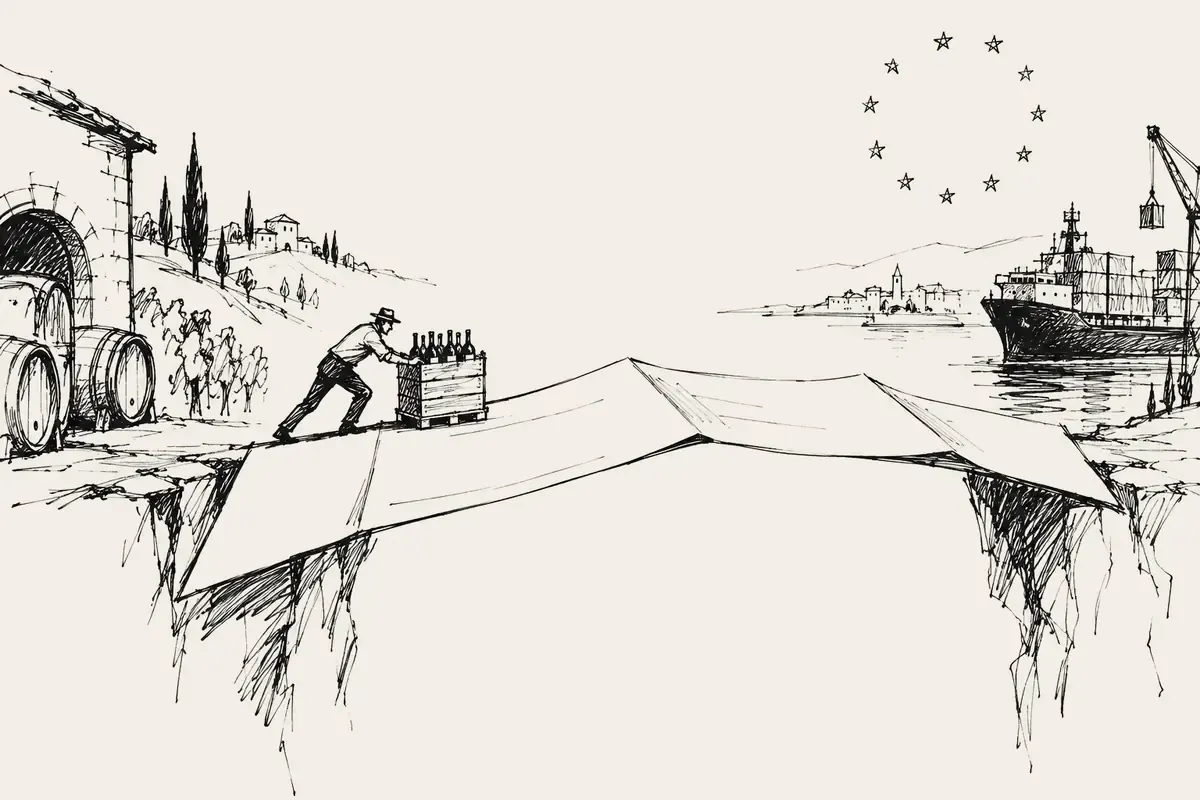
- The EU's OCM scheme co-finances part of what you spend promoting wine in non-EU markets. It is co-financing reimbursed against proof of spend, not a loan and not free money.
- Eligible spend is broad: trade fairs, tastings, PR, and the prospecting and outreach that build an importer pipeline. Outsourced outreach work often qualifies.
- It covers non-EU markets only, the US, UK, Switzerland, Japan and the like. The application is administratively demanding, so many producers apply through their interprofession or an advisor.
Contents
A surprising number of European producers never find out that part of what they spend reaching foreign importers can be co-financed. This is public co-funding designed to help EU wineries sell outside the EU: you commit the spend, and a share of the eligible cost is reimbursed afterwards. Most producers miss it because the programs are written in administrative language and run by bodies that do not market themselves. Here is what the scheme covers, who can apply, and what the process asks of you.
What the scheme is
Across the EU there is a long-running wine promotion scheme, part of what is called the Common Market Organization, or OCM. Its purpose is to make European wine more competitive in markets outside the EU. It co-finances promotional work in those markets, and historically the headline rate has been up to half the eligible cost. Each member state runs its own version, so the detail below is EU rules applied nationally, with French examples. In France it is administered by FranceAgriMer under the "promotion in third countries" program. Italy and Spain run their own national calls under the same EU umbrella. If you are outside the EU, this particular scheme does not apply to you.
There is important news here for 2026. Faced with a wine sector under real pressure, the EU adopted a reform package in early 2026 that, among other things, lifted the co-funding ceiling for third-country promotion. The EU share can now reach up to sixty percent of eligible cost, member states are allowed to add national funding on top, and the combined public contribution can run as high as eighty percent in some cases. The same reform lengthened how long a project can be supported, to three years and renewable. Two qualifications matter. National calls already published for the current campaign were built on the older fifty percent rate, so what you can claim depends on which call you apply to and when, and the higher ceilings flow through as countries update their programs. And a published rate is a ceiling on what may be co-financed, not a guarantee that a given application will be accepted or funded in full. Check the live figure for your country before you budget around it.
The scale of the funding
The envelopes are substantial. France's most recent annual third-country call ran to around eighty million euros. Italy's equivalent national call was larger still, comfortably into the high tens of millions, with a sizeable cap per project. These budgets are distributed every year, and small producers are often absent from the applicant pool, sometimes simply because they do not know the scheme exists.
Non-EU markets only
The scheme covers promotion in non-EU markets only. That means the United States, the UK (now outside the EU), Switzerland, Japan, Korea, China, and so on all qualify. Selling within the EU, to Germany or the Netherlands for instance, falls under different rules. So the scheme fits export plans aimed beyond the EU's borders, and not intra-EU sales work.
What counts as eligible spend
Eligible activities are broad. They typically include trade fair stands, tastings, public relations, advertising, inviting importers and journalists to visit your winery, market studies for a new country, and the market prospecting and digital outreach that finds new buyers. In other words, the work of building an importer pipeline in a foreign market, the cold outreach, the campaign setup, the prospecting, is frequently the kind of cost these grants are meant to cover. Eligibility is set call by call, so confirm the categories against the current national call rather than assuming them.
You commit the spend, and a share of the eligible cost is reimbursed afterwards.
Outsourced outreach to connect a producer with importers abroad, including the kind of work we do, falls for many producers into this category of eligible promotional spend, with part of the cost potentially reimbursable.
How to apply and claim
The administrative side is substantial. Applications run on annual deadlines, you usually build a project per target country, projects span multiple years, and you generally pay first and are reimbursed against proof of spend. That last point shapes the cash flow: the co-financed share arrives after you have spent it, and you carry the balance in the meantime. The smoothest path for a small producer is rarely going it alone. Many apply through their interprofession or a collective body, which can bundle smaller producers into a single stronger application, or lean on an advisor who handles these files for a living. Your regional chamber of commerce or wine council is the right first call.
We are not grant consultants, and the rules shift year to year, never more than now with the 2026 reform bedding in, so anything specific needs checking against the current national call. The principle, though, is stable: part of the cost of promoting your wine outside the EU can be co-financed. Before you treat your export budget as money you have to find in full yourself, find out what share of it the scheme could cover.


