The short version
- A trade show buys concentrated face-time and discovery in three days. For some producers that is worth the outlay.
- It is also a major outlay, booth, build, travel, samples and three demanding days, and the contacts you collect are worth little until someone follows them up.
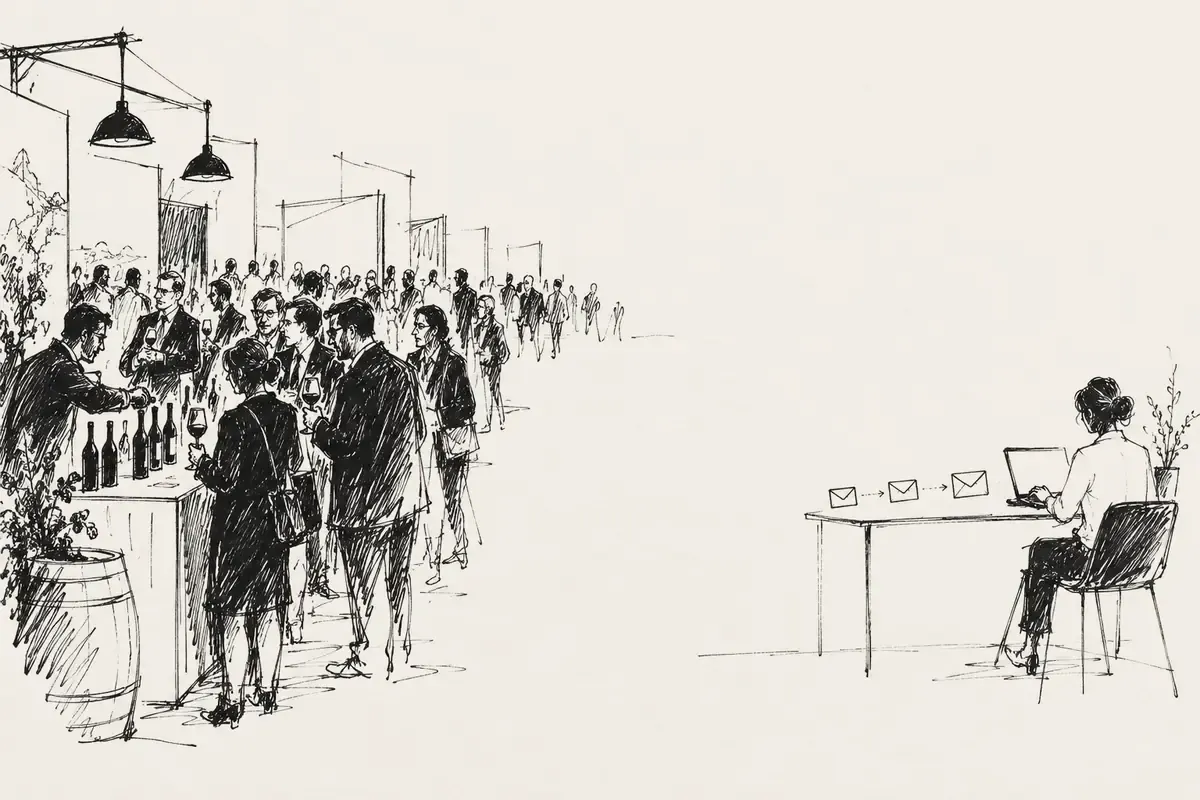
- A show is an event, not a process. It covers three days a year. Email outreach runs across the calendar, prepares meetings before a show and follows them up afterward. For most producers the two work best together.
Contents
If you are reading about ProWein or Vinexpo, you are probably weighing whether to exhibit and whether the cost is justified. It is a fair question, and the answer is not a simple yes or no. Trade shows do something no other channel does. They also cost more than most producers budget for, and they leave undone the task that turns a contact into a customer. The aim here is not to talk you out of a show. It is to set out what you are buying, so you can decide whether to buy it, and what to pair it with.
What ProWein and Vinexpo are
These are the two largest events in the wine trade calendar. ProWein, held every March in Dusseldorf, has long been the biggest wine and spirits fair in the world, drawing thousands of exhibitors and tens of thousands of trade visitors from well over a hundred countries. Wine Paris, the Vinexpo event held every February, has grown quickly and recently overtook ProWein on visitor numbers for the first time, passing fifty thousand visitors. Between them they concentrate much of the international wine trade into a few halls on a few days, and that concentration is what they sell.
It is worth knowing that the picture is shifting. ProWein's attendance has slipped in recent years, with exhibitor and visitor numbers down from their peak, while the Paris fair has climbed. The shows are not a fixed quantity, and where the buyers you want actually go matters more than which fair is biggest this year.
What a show delivers
The format has genuine strengths. In three days you get face-time you could not buy any other way: a buyer tastes your wine, in person, alongside its competitors, and you read the reaction as it happens. You get discovery, the chance encounter with an importer who was not looking for you and finds you anyway. You get the handshake and the human connection that a relationship-driven trade still runs on. And you get density, dozens of conversations compressed into a few days, in a setting where everyone present is there to do wine business. For a producer entering a new market, or one whose wine needs to be tasted to be understood, that can justify the cost on its own.
What a show costs
The stand fee is only the beginning. At a major fair the bare floor space is charged per square meter, the stand build is charged again on top at a few hundred euros per square meter, and then come the costs that rarely make the budget: travel, accommodation in a city where hotel prices rise sharply during the fair, shipping samples, glassware, printed materials, and the days of your own time before and during. What that totals depends on the fair, the stand size and how far you travel, but a modest independent stand at a major show commonly runs from the high thousands into the tens of thousands of euros once everything is counted. Regional and collective pavilions, often part-subsidized by a trade body or interprofession, are the cheaper route in and worth seeking out, though they still cost you the days.
Then there are the three days themselves. Standing for eight hours, talking to everyone who passes, collecting cards and scribbled notes, hoping the right buyer comes by at a moment you are not mid-conversation with someone else. It is demanding work, and at the end of it you go home with a stack of contacts and a sense of momentum.
What happens to the leads afterward
The contacts you carry home from a show are not deals, and they are not yet qualified importers. They are names that have to be contacted, qualified and pursued in the weeks afterward, and that is where most of the value tends to be lost. Cross-industry research on trade shows has repeatedly found that a large share of show leads are never followed up; figures around eighty percent are widely cited, though they come from general B2B studies rather than from the wine trade specifically. The order of magnitude is the useful part. Many fair contacts are followed up late or not at all, after the money has already been spent to collect them.
This is a common reason producers conclude that a show did not work. Often the show did work: it put the right people in front of them. What failed was the follow-up, the patient, repeated contact that a producer back at a working winery, in the middle of a season, rarely sustains. A show is an event. Turning its contacts into business is a process, and the show does not provide one.
You get the handshake and the human connection that a relationship-driven trade still runs on.
Cost per lead, as a scenario
Set the two approaches side by side and the economics become clearer, though the numbers depend entirely on your own inputs. A show concentrates a lot of contact into a high fixed cost, incurred whether or not those contacts convert. Targeted email outreach spreads a lower cost across a campaign that reaches a chosen list of importers, in the markets you want, on a schedule, with the follow-up built in. Whether outreach works out cheaper per qualified lead depends on the fair's fees, your stand size, your travel and, above all, how well the contacts from either channel are worked afterward. What can be said with more confidence is that a show's cost is front-loaded and one-off, while a list, a set of sequences and the relationships they build carry forward into the following year.
Not either-or
Treating this as a choice is the mistake. The producers who get the most out of a show are the ones who run outreach around it. Before the fair, you email the importers you most want to meet and book appointments, so your three days are spent with qualified buyers rather than with whoever passes the stand. After the fair, you put every contact you collected into a proper follow-up sequence, which is the step most exhibitors skip, so the leads you paid to gather are actually worked. Outreach is what makes a show pay. It covers the rest of the calendar, prepares the meetings before you arrive, and follows up the contacts after you leave.
When a show makes sense, and when outreach is the better use of budget
Decide deliberately. A show makes sense when you are entering a market where your wine has to be tasted to be understood, when you can afford the outlay without staking the year on it, and when you have a plan to work the contacts afterward. Email outreach is the better use of a limited budget when precision matters more than presence, when your markets are spread across regions a single fair cannot cover, or when you need something that runs all year rather than for three days.
That is the distinction that matters. A trade show is three days a year. Reaching importers is a year-round job. A fair can be a valuable part of the plan without being the whole of it, because few deals are concluded on the show floor. They are concluded in the weeks of follow-up afterward, which is the work steady outreach is built to do.


